Pillars of actions WINSA

Accueil » WIN South America » Pillars of actions WINSA
4 pillars of actions

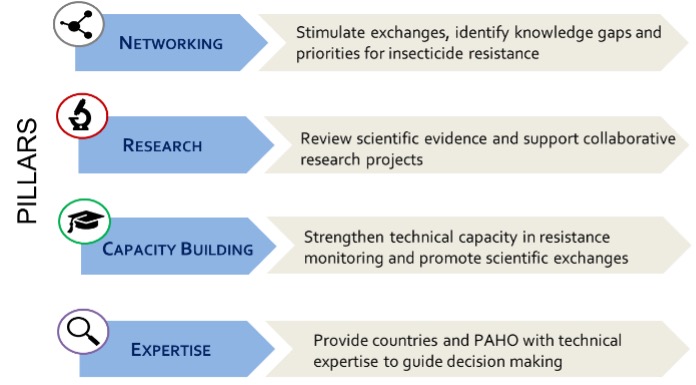
The network relies on 4 pillars  of actions in order to raise awareness, fill knowledge gaps and strengthen research & training capacities on vector resistance surveillance and management in South America (Fig. 1)

Strengthening Networking Among Vector Resistance Researchers

Annual partner meetings to facilitate knowledge-sharing, identify gaps, and plan and coordinate the activities of the WINSA network.

Biennial conferences to raise awareness, foster innovation, support translational research, engaging scientists, students, stakeholders, and international organizations.

Establishment of communication networks among WINSA members to routinely share information and best practices regarding insecticide resistance research and surveillance.

Filling Research Gaps and Developing

Resistance Mitigation Strategies

Research conducted through Working Groups on priority topics, such as vector distribution, resistance mechanisms, population genetics and diagnostic methods.

“Pump Prime Funding” (PPF) support for collaborative research projects among WINSA partners.

Public-private partnerships to promote innovative insecticide resistance mitigation and vector control strategies.

Building Capacity in Insecticide Resistance Monitoring

Training courses for researchers, students, and program staff to strengthen capacities for monitoring insecticide resistance, with workshops scheduled in Colombia (2025) and Brazil (2026).

Sharing of educational resources, including manuals, protocols, and video tutorials, based on WHO-recommended testing methods.

Short-term scientific exchanges to promote career development and skill acquisition among early-stage researchers.

Strengthening Expertise in Vector Surveillance for Informed Decision-Making

Contributions to the development of a centralized vector resistance repository for South America, creating regional “threat” maps to guide vector control actions.

Participation in national (eventually international) expert committees, offering guidance on vector control and resistance management.

Coordination of multi-centre trials to advance new testing methodologies and assess alternative control tools and strategies.